Blog
Why NPS is the Smart Investment Option for Building Retirement Corpus?
Planning for life after retirement shouldn’t be stressful, as a relaxed lifestyle, spending time with family, or traveling without worrying is possible with strong financial planning. Many people assume that retirement planning is complicated, but that is exactly where the National Pension System makes it simpler.
It is a government-backed, highly flexible, and incredibly cost-effective way to build a retirement corpus. If you are considering where to invest your savings for the future, NPS is the right option for you.
Let’s understand the reason why making an NPS investment is one of the smartest financial decisions you can make for your future.
Top Reasons to Invest in NPS
1. Tax Saving Option
Due to the tax-saving option that it offers, National Pension System is one of the major reasons people invest, especially if a person is filing their taxes under the Old Tax Regime. The government offers tax benefits to encourage individuals to save for their retirement.
A subscriber is eligible for a tax deduction of up to ₹1.5 lakh under Section 80CCD(1), which is a part of Section 80C under the Old Tax Regime. In addition, Section 80CCD(1B) allows subscriber to claim an extra deduction of ₹50,000, separate from the 80C limit, which means an individual taxpayer can reduce their taxable income by up to ₹2 lakh every year.
Furthermore, if a salaried employee invests in Corporate NPS, their employer can also contribute to their account, which offers extra tax benefits under Section 80CCD(2).
2. Solid Government Backing
If an individual is saving money for 20 or 30 years, trust matters most, as they want to be sure that the money invested is accessible when they retire. The National Pension System framework is completely regulated by the Pension Fund Regulatory and Development Authority (PFRDA), which means the funds are managed by registered, highly qualified Pension Fund Managers (PFMs) who operate under strict investment guidelines.
3. Flexibility to Match Risk Appetite
Unlike traditional fixed deposits or provident funds that offer a fixed interest rate, National Pension System gives more control over investment. It helps to recognize that a 25-year-old and a 50-year-old have different abilities to handle risk. One can decide how their money is divided among four asset classes: Equity (stocks), Corporate Bonds, Government Securities, and Alternative Assets as a subscriber.
- Active Choice: If subscribers understand the market, they can manually allocate up to 75% of their funds into equity to chase high growth.
- Auto Choice: If subscribers prefer auto choice, the lifecycle fund automatically manages their risk, as it keeps their equity exposure high when they are young and shifts their money into safer government bonds as they get close to retirement.
4. Compounding Returns
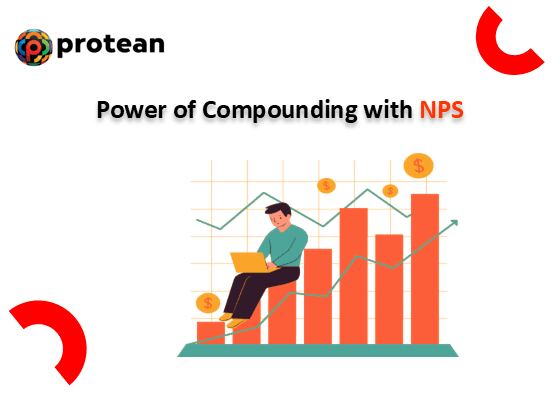
The advantage of a long-term NPS investment lies in the compounding returns. Since the NPS is market-linked a market-linked retirement scheme, especially the equity allocation, it delivers higher returns than traditional savings options. Even a small monthly contribution for 25 or 30 years consistently creates a corpus worth crores.
5. Cost-Effective
The fund management charges for the NPS are low, around 0.01% to 0.09%. Due to which a much larger portion of money stays invested in the market, which increases the retirement corpus.
6. Portability Option
In a modern work environment, individuals frequently switch jobs from a corporate office. For example, an individual in Mumbai moves to a startup company in Bengaluru or might even decide to quit and become a full-time freelancer. Here’s where the National Pension System simplifies retirement planning by issuing a Permanent Retirement Account Number (PRAN), unlike traditional corporate provident funds, where changing jobs require paperwork to transfer accounts.
7. Monthly Income After 60
When a subscriber turns 60, the scheme protects from spending all their money at once. They can withdraw up to 80% of their total accumulated corpus, out of which 60% is tax-free as a lump sum. The remaining 20% must be used to purchase an annuity, that acts as a fixed salary, providing a steady, guaranteed monthly pension for life.
Conclusion
Building a stress-free and wealthy retirement is no longer a challenging task, all it requires is discipline and the right investment choice.
Since the National Pension System offers tax benefits and long-term growth, it makes a suitable choice for subscribers to invest in it for their retirement planning.
Whether an individual has just started their first job or is well into their career, NPS is the best investment option today to prioritize for the future.
Make the smart move, open NPS account, and watch your wealth grow.
Frequently Asked Questions (FAQs)
Q1: Can I withdraw my money from the scheme before I turn 60?
Yes, the National Pension System only allows partial withdrawals (up to 25% of your own contributions) after completing a three-year lock-in period for critical events such as higher education for children, buying a house, or severe medical emergencies.
Q2: How much do I need to invest every year to keep my account active?
To keep your primary Tier-I account active, you only needs to make a minimum contribution of ₹1,000 per financial year, as there is no maximum limit, so you can invest as much as your budget allows.
Q3: What is the difference between a Tier-I and a Tier-II account?
The Tier-I account is your mandatory, long-term retirement fund that offers all the tax benefits. Whereas the Tier-II account is a voluntary, flexible investment account that offers the same low-cost fund management but allows you to withdraw your money at any time and generally do not offer tax deductions.
Related Articles