
Blogs
Aadhaar OTP vs. Biometric Verification: Which is Better for Your Business Onboarding?
How effective is Aadhaar OTP verification when compared to other authentication methods?
Identity verification is the backbone of the 2026 digital economy. Indian businesses need to prioritise speed and security to cater to customers in a saturated market.
The main factor for any digital interaction is trust. A seamless onboarding process can easily differentiate a successful platform from those struggling with high drop-off rates.
Aadhaar verification online is an advanced modern solution to establish this trust and reduce the risk of frauds. Companies can select the mode of verification that can balance user convenience with regulatory compliance.
Choosing Aadhaar OTP verification and biometric verification can determine the efficiency of your customer acquisition strategy. Organisations can use these technologies to reduce fraud and streamline their operations.
Understanding Aadhaar OTP Verification
Aadhaar OTP verification has transformed remote business interaction with customers. It utilises the mobile number linked to a user's Aadhaar record for identity validation.
- A user can simply enter their Aadhaar number
- Receive a One-Time Password (OTP) on their registered device
- A rapid digital loop is created that confirms identity in seconds.
Aadhaar verification online through OTP can also considerably reduce the need for physical paperwork and long waiting periods.
With this approach, your business can gain a considerable advantage in speed and lower drop-off rates.
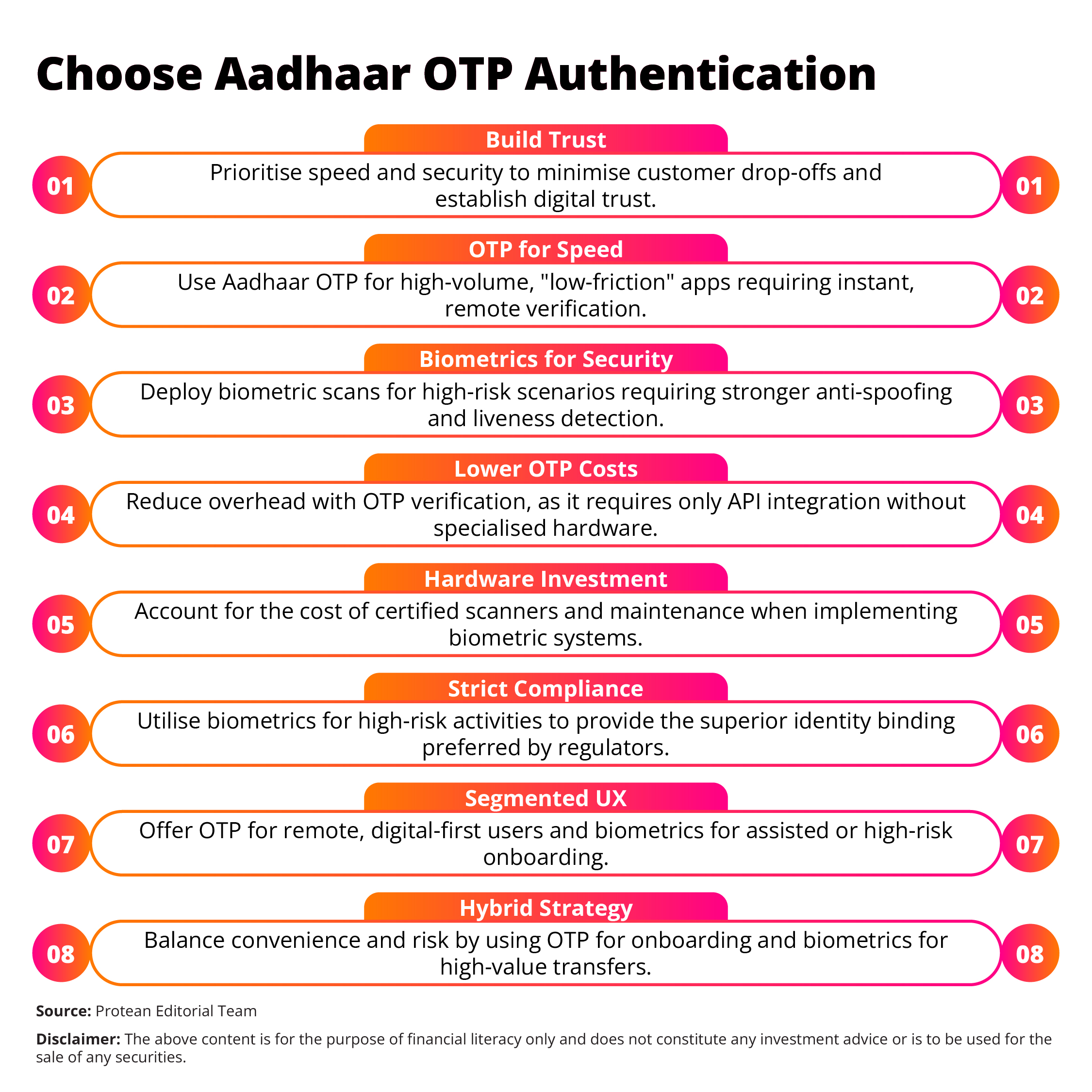
Modern consumers seeking instant gratification might abandon applications requiring complex steps.
Aadhaar-based OTP verification can meet this expectation by offering a hassle-free onboarding experience. It can be better for high-volume applications where user convenience is of the utmost importance.
Protean eGov Technologies can provide APIs that integrate this capability directly into your app or website. This integration can drive cost efficiency by removing manual checks. Thus, you save money on physical document storage and personnel hours. It also ensures that your business scales effortlessly without the logistical burden of offline checks.
When High-Security and Physical Presence Matter
Certain scenarios require a higher level of assurance than what a remote OTP can provide. Biometric verification can offer the superior choice when physical presence and maximum security are non-negotiable.
This method matches unique biological traits, such as fingerprints or iris scans, against the central UIDAI database. Biometric verification can prove to be challenging for fraudsters to spoof compared to an intercepted OTP. This method also needs the individual to be physically present at the point of service.
To prevent impersonation, retail branches, bank kiosks, and field agents are heavily dependent on biometric verification. Loans above certain thresholds or high-risk accounts often use this check to mitigate financial exposure.
Let us now compare these two methods.
Aadhaar authentication through biometrics can provide a concrete audit trail which regulators might require for sensitive financial transactions. However, biometric verification also serves an inclusive purpose for users lacking a linked mobile number or technical literacy.
But the two methods can work better in combination.
For example, field agents equipped with biometric devices can onboard customers in rural areas effectively. Similarly, high-value transactions benefit from the high security of biometric verification. This method might also be able to protect the users against identity theft and unauthorised access.
Therefore, Aadhaar verification online through biometrics can be an indispensable shield for sectors where risk management takes precedence over speed.
Cost, Compliance, and User Experience
Here are the comparative advantages of each method across three critical pillars: Cost, Compliance, and User Experience.
Cost Efficiency - Aadhaar OTP verification can have lower operational costs. It requires no specialised hardware. Thus, your business only needs to pay for the API calls. But biometric verification requires the initial investment in certified scanners and devices (online or offline). You also need to maintain these devices. This cost too adds to the total cost of ownership.
Compliance and Security - Both methods can offer strong compliance with KYC regulations. Aadhaar authentication creates a verifiable digital trail for auditors. But biometric verification is often preferred by regulators for high-risk activities due to stronger identity binding. Aadhaar OTP verification can satisfy the requirements for most standard customer onboarding scenarios and low-risk financial products. With Aadhaar verification online, you can meet the "Know Your Customer" mandates effectively.
User Experience - Aadhaar OTP verification can offer better convenience compared to biometric verification. Here, the user simply has to complete the process from the comfort of their homes. But biometric verification requires the user to visit a branch or meet an agent with a scanner. This physical requirement might introduce friction but provides a "high-touch" experience that some customers prefer for serious financial commitments.
Thus, your choice between the two verification options needs to align with the specific journey your customer takes.
Aadhaar verification online via OTP might be better for the digitally savvy customers, and biometric verification might work better as the assisted model.
Which One Should Your Business Choose?
Aadhaar OTP verification is embedded with features that can offer low-friction, high-volume applications. Digital wallets, e-commerce platforms, and entry-level fintech apps extensively use this method.
It enables onboarding thousands of users daily with minimal bottlenecks, subject to UIDAI limits. The speed of Aadhaar OTP verification can directly correlate with higher conversion rates for these services. Users appreciate the ability to instantly verify their identity without leaving their couch.
But Aadhaar verification online through OTP and biometric verification can make a smart combination for businesses. This can be a hybrid model working better for comprehensive service providers.
Here, you can use Aadhaar OTP verification for the initial login or basic account creation. Subsequently, you can mandate biometric verification for processing loans or unlocking high-value transfers. Adopting a layered approach balances convenience with security. With this approach, you can capture the market with easy entry while protecting your assets with robust checks later.
Streamlining background checks with Aadhaar verification online also considerably benefits the gig economy. Aadhaar authentication can also provide the flexibility to design these workflows. Your business can assess the risk associated with each transaction type. Higher risk requires biometric verification, while high growth demands Aadhaar OTP verification.
Conclusion: The Strategic Differentiator
Aadhaar verification online can empower your business to operate with speed and integrity. The decision between Aadhaar OTP verification and biometric verification would depend on your specific risk appetite and customer engagement model.
Businesses can integrate both to cover the entire spectrum of user needs. Thus, Aadhaar authentication can serve as the foundation for a secure digital ecosystem. The right verification strategy can accelerate growth and build lasting customer loyalty.
Frequently Asked Questions (FAQs)
Q1: Is Aadhaar OTP verification safe for high-value transactions?
Aadhaar OTP verification is highly secure for most transactions. RBI guidelines limit Aadhaar OTP to low-risk transactions, with banks using biometric or face verification for high-value loans to ensure stronger security.
Q2: Can I use Aadhaar verification online for all customers?
Yes, Aadhaar verification online can work for any customer with a valid Aadhaar number. Similarly, biometric verification can help businesses who may not have their mobile number linked or updated.
Q3: Does Aadhaar authentication require specific hardware?
Biometric verification requires certified scanners. But Aadhaar OTP verification only requires a software integration, making it hardware-independent.
Q4: Which method is faster for customer onboarding?
Biometric verification requires physical interaction, which takes more time. But Aadhaar OTP verification can be faster as it occurs remotely and instantly.
Q5: Can Aadhaar verification online reduce costs?
Aadhaar OTP verification reduces manual paper handling, physical storage, and verification staff. Aadhaar OTP verification specifically reduces the need for physical branches.
Related Articles