Blogs
Combining Passport Verification with Biometrics for Maximum Security
How many places do you think passport verification is required and useful?
The concept of identity in 2026 relies on digital-first validation.
Now, you can no longer rely only on a physical ID card or a static number. Currently, businesses are facing an advanced wave of synthetic identity fraud. Here, criminals use real data to create fake personas. Such frauds cost the global economy billions annually. It also forces enterprises to rethink their security perimeters.
Passport verification data and biometric telemetry can form a synergy setting the new gold standard for B2B security. It combines the authoritative trust of a government-issued document with the biological certainty of facial recognition. Thus, companies can build a "Zero Trust" environment that is both secure and seamless.
Why Passport Number Verification is No Longer Enough
Passport number verification alone might leave certain security gaps. Stolen passport details can freely circulate on the dark web. Meaning, a valid number might not guarantee that the person presenting it is the legitimate owner.
Criminals can easily purchase these valid credentials and use them to bypass basic static checks.
Also, global databases might suffer from "database lag." A passport that is reported lost or stolen in one country might take days or weeks to appear in international registries.
During this window, the document remains usable for fraudulent transactions. Similarly, a "Face-to-File" disconnect can also occur.
Thus, the system might only confirm that a passport exists and is valid. However, it can’t confirm that the user holding the device is the authorised holder.
So, without a biometric link, passport verification is incomplete. It is only validating the data but not the human behind it.
How Biometrics Secure the Verification Loop
Biometrics can close this security loop that static data has left open.
A passport verification API integration with biometric capabilities can add a layer of indisputable proof. The process begins with OCR (Optical Character Recognition) that scans the passport to extract data. But the real security kicks in with facial matching.
The system compares the high-resolution photo extracted from the passport's data page or NFC chip against a live selfie taken by the user.
To prevent spoofing, advanced verification API technology uses liveness detection. Thus, the user is proved to be physically present and not holding up a photo or using a deepfake video.
The technology can also analyse micro-movements. These can be blinking or the natural reflection of light on skin, to confirm "liveness." Such a 1:1 matching binds the digital passport verification result to the physical user in real-time. Therefore, businesses can considerably reduce the risk of impersonation and account takeovers.
B2B Use Cases for Passport Verification API
Let us learn about the use cases of passport verification API technology.
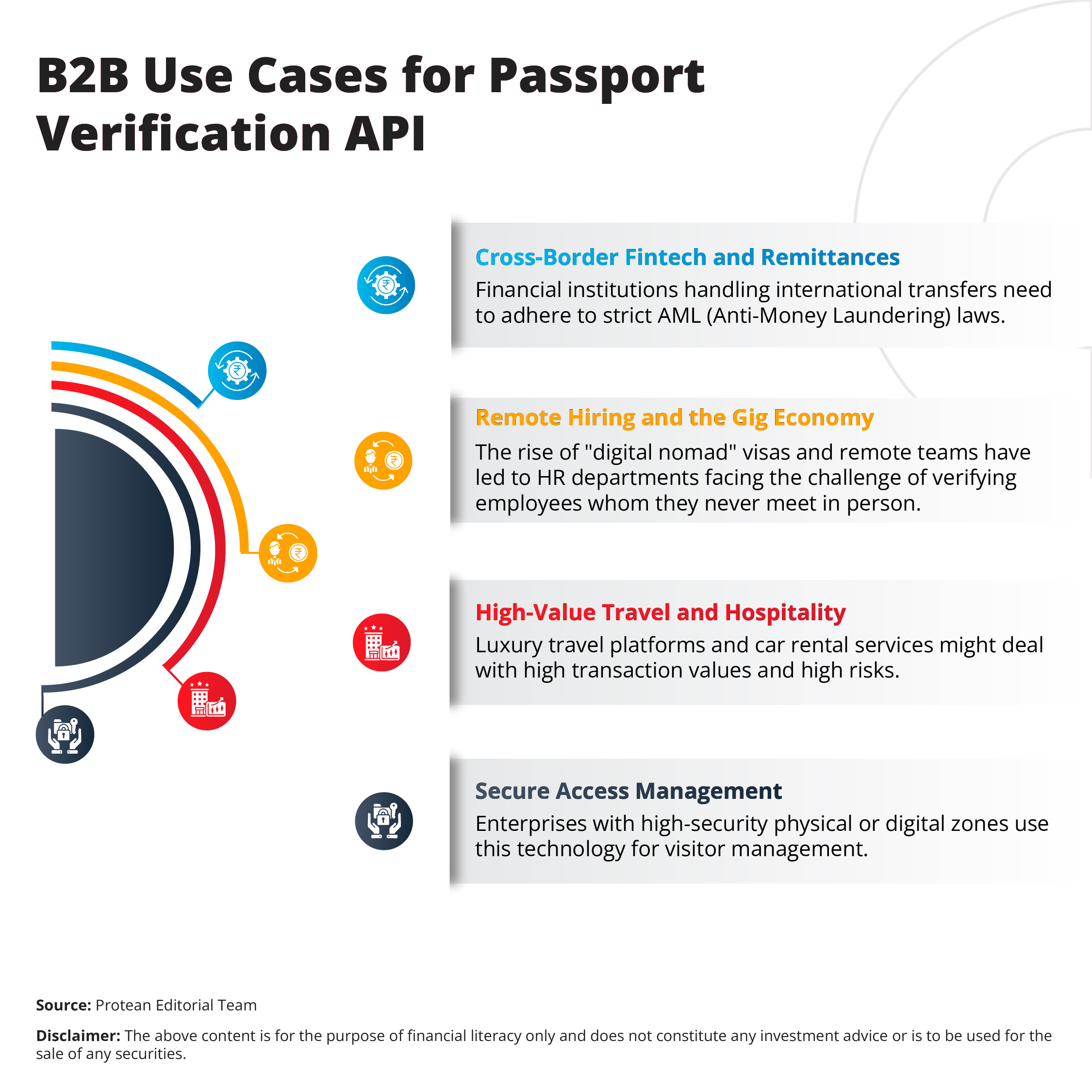
- Cross-Border Fintech and Remittances: Financial institutions handling international transfers need to adhere to strict AML (Anti-Money Laundering) laws. Passport verification APIs enable these firms to validate the sender's identity instantly, regardless of their country of origin.
- Remote Hiring and the Gig Economy: The rise of "digital nomad" visas and remote teams has led HR departments to face the challenge of verifying employees they never meet in person. Passport number verification combined with biometric scans ensures the person in the video interview matches the one submitting the employment documents. This prevents "candidate bait-and-switch" fraud.
- High-Value Travel and Hospitality: Luxury travel platforms and car rental services might deal with high transaction values and high risks. Integrating passport verification proves a customer’s booking of a villa or supercar is legitimate. It creates a digital audit trail that insurance underwriters and risk teams can depend on.
- Secure Access Management: Enterprises with high-security physical or digital zones use this technology for visitor management. Instead of manual logbooks, kiosks scan passports, match faces, grant access only to verified personnel. This scrutiny matches Aadhaar authentication in government facilities but applies to a global visitor base.
Implementing the Stack: Choosing a Robust Passport Verification API
A superior passport verification API can offer seamless integration via RESTful architecture. It can also help your engineering team plug it into your existing stack with minimal friction.
Platforms like Protean eGov Technologies provide solutions that prioritise speed and compliance equally. It offers API technology that delivers fast response times for efficient verification.
The chosen API should also adhere to global standards like GDPR and local regulations like the DPDP Act. It should support data minimisation, where the system validates the passport number verification request without storing the raw image data longer than necessary. Businesses can look for features like verification status and risk indicators in the response. They can give your risk engine more granular data to make automated decisions.
Conclusion: Future-Proofing the Business Perimeter
Security in 2026 demands a "Zero Trust" approach to identity. Businesses cannot simply depend on legacy methods due to their inherent risks.
Investing in a biometric-backed passport verification API can signal to your customers and partners about your priority towards their safety and data integrity.
As fraud evolves, your defenses must evolve faster. The combination of authoritative passport data and advanced biometrics provides the strong shield your business needs.
Request a demo of our passport verification API to see these features in action.
Frequently Asked Questions
Q1: Can the passport verification API detect deepfakes?
Yes. Modern passport verification solutions utilise active and passive liveness detection. These systems can analyse pixel-level data to distinguish between a real human face and a deepfake or screen replay, ensuring high-assurance validation.
Q2: Is the user's biometric data stored?
Generally, passport verification API providers process biometric match in real-time and discard the raw biometric data immediately, storing only the verification status and audit logs to ensure privacy compliance.
Q3: Does passport number verification work for all countries?
A majority of enterprise-grade APIs support Machine Readable Zones (MRZ), standardised globally by ICAO. Thus, the passport verification API can extract and validate data from passports issued by over 190 countries, ensuring wide-ranging compatibility.
Related Articles